Fractional distillation is a process in which two or more miscible liquids can be separated by boiling the solution until the liquid of the lower boiling point vaporizes. That vapor is passed in a fractional or water condenser to make them condense and turn back from vapor to liquid. This pure liquid is collected in separate vessels, while the solid or other liquid from the solution remains in the distillation flask. This process is called fractional distillation.
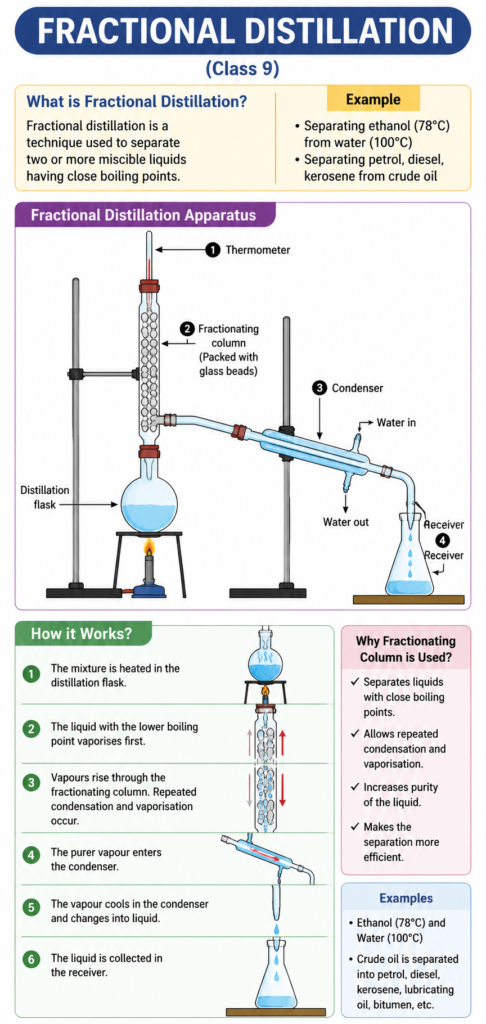
It is generally preferred when the difference of two liquid or solid boiling points is less than about 25°C. This is widely asked in class 9 question.
How Does Fractional Distillation Work?
- The mixture or solution that contains two or more miscible liquids is heated in a distillation flask.
- Those liquid who has lower boiling point convert into vapor first.
- These vapors rise and pass through the fractionating column.
- The fractionating column causes repeated condensation and evaporation Getting more pure liquid.
- The purified vapor then enters the condenser.
- The condenser cools the vapor and changes it into liquid.
- The liquid is collected in another vessel.
Uses of Fractional Distillation
There are lots of uses of fractional distillation in industry, laboratories, and making medicine.
Example 1: Alcohol and Water
We know that alcohol and water have different boiling points. such as alcohol, which boils at 78°C, while water boils at 100°C. So by the help of fractional distillation, alcohol and water are separated.
Example 2: Crude Oil
Fractional distillation is used to separate crude oil into many useful fuels that we use in daily activities of our lives, like:
- LPG (Petroleum gas)
- Petrol
- Naphtha
- Kerosene
- Diesel
- Lubricating oil
- Bitumen
Applications of Fractional Distillation
- It is used for separating ethanol from water
- It helps to refine crude oil into useful fuels like petrol, diesel, kerosene, etc.
- It helps to separate oxygen and nitrogen from liquid air
- It helps to purify chemical compounds in laboratories
| Simple Distillation | Fractional Distillation |
|---|---|
| Used when boiling points differ greatly, more than 25°C | Used when boiling points are close |
| No fractionating column used | Uses a fractionating column |
| Less efficient and not much gets pure substance | More efficient |
| It is suitable for separating liquid from dissolved solids | Suitable for separating two or more miscible liquids |
I Hope you find this solution helpful, my dear students, please follow on instagram page or subscribe our youtube channel to connect with us.
Rate this article
Tap a star to rate
Was this helpful?
Sorry to hear that — what can we improve?
✓ Thanks for your feedback!