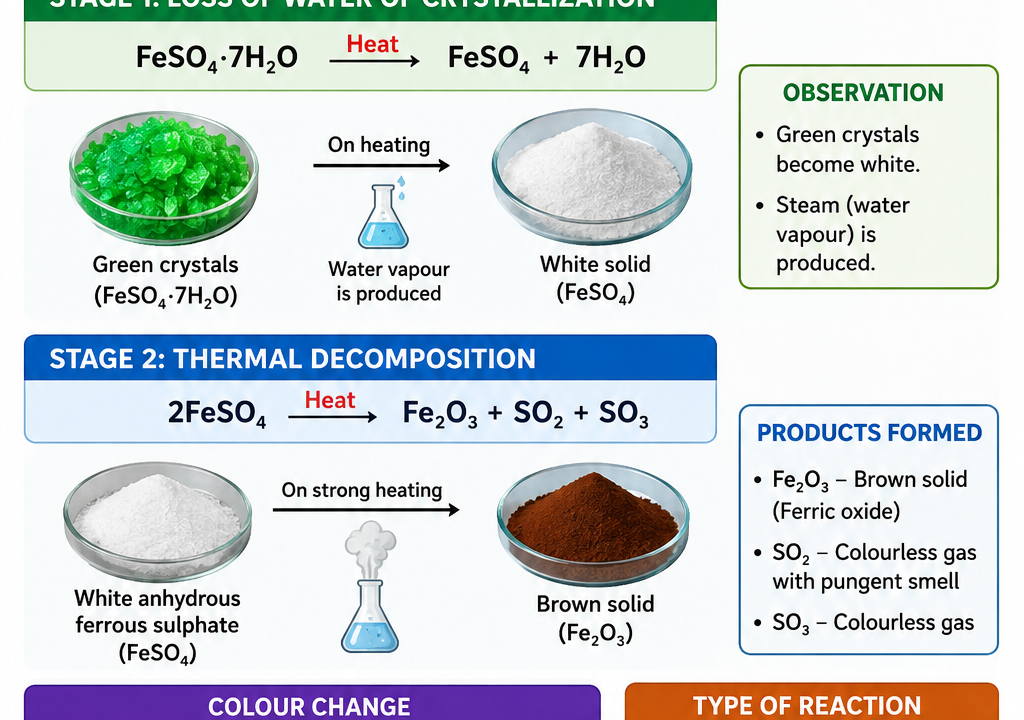

When Ferrous Sulphate (FeSO₄·7H₂O) is heated then it start losing water and form anhydrous ferrous sulphate (FeSO₄), which is further heated and forms Ferrous Sulphate (Fe₂O₃) , sulfur dioxide (SO₂) and sulfur trioxide (SO₃).
What is Ferrous Sulphate?
Ferrous Suphate is one of the most important compounds in chemistry. It is green in color and its chemical formula is FeSO₄·7H₂O. It has the common name green vitriol in chemistry.
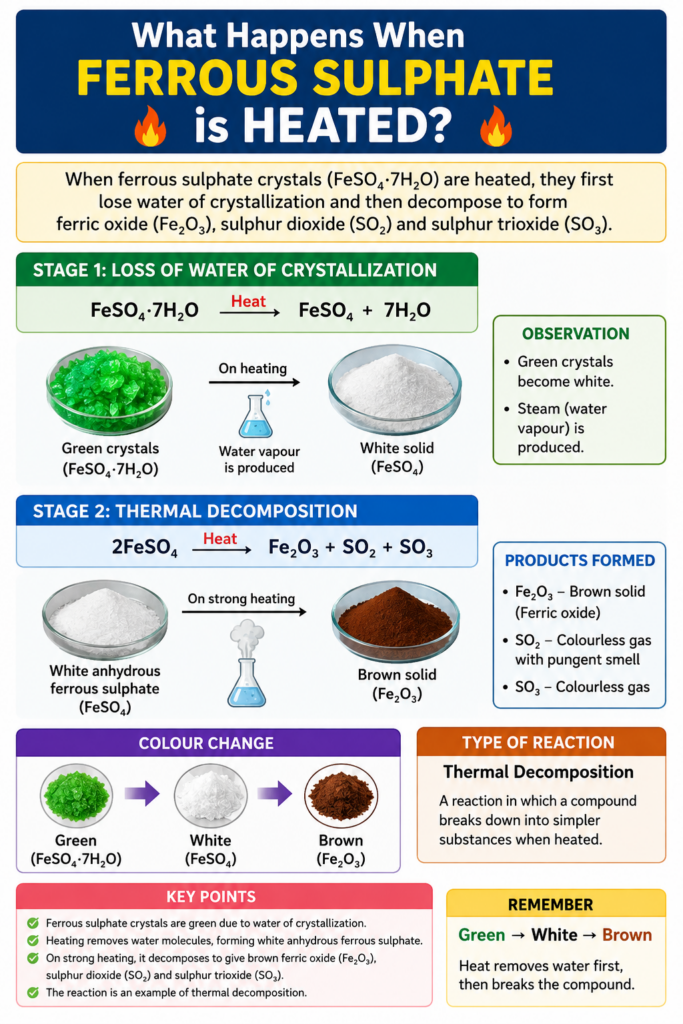
What Happens When Ferrous Sulphate is Heated?
Heating of ferrous sulphate occurs in two stages.
Stage 1: Loss of Water of Crystallization
When ferrous sulphate crystals are heated slowly then it lose seven molecules of water.
Chemical Equation
FeSO4·7H2O ⟶(Heat) FeSO4 + 7H2O
Observation
- Green crystals of ferrous sulphate become white because 7 molecule of water is removed during heating.
- Water vapor is produced in this stage.
Stage 2: Thermal Decomposition takes place
On strong heating further, the white anhydrous ferrous sulphate start decompose.
Chemical Equation
2FeSO4 –Heat–> Fe2O3 + SO2 + SO3
Products Formed
| Product | Formula | Nature |
|---|---|---|
| Ferric oxide | Fe₂O₃ | Brown solid |
| Sulphur dioxide | SO₂ | Colorless gas with a pungent smell |
| Sulphur trioxide | SO₃ | Colorless gas |
Colour Change
| Before Heating | After Gentle Heating | After Strong Heating |
|---|---|---|
| Green crystals | White solid | Brown solid |
Real-Life Applications of Ferrous Sulphate
Ferrous sulphate has wide use in laboratory and industries.
- it is used in manufacturing pigments
- In the laboratory it is used to making Iron supplements to treat anaemia
- it is used in Water treatment plants to purify it.
- it acts as a Fertilizers in soil
- Dyeing and textile industries used it for providing color to cloths.
Easy Trick to Remember
Green → White → Brown
- Green = FeSO₄·7H₂O
- White = FeSO₄
- Brown = Fe₂O₃
I hope you find the answer helpful, My dear students please rate our post. It motivated me to write more!
Rate this article
Tap a star to rate
Was this helpful?
Sorry to hear that — what can we improve?
✓ Thanks for your feedback!