
What is Mixture ?
When two or more substance are mixed together without undergo any chemical reaction then it said to be mixture.
For example : when we take salt and water, and mix it then it doesn’t do any chemical reaction since, these forms mixture. Here no new substance are formed. They just mix up.
Another example , suppose we take sand and water, if we mix it then it doesn’t go any chemical reaction , this also forms a mixture. Here no new substance are formed.
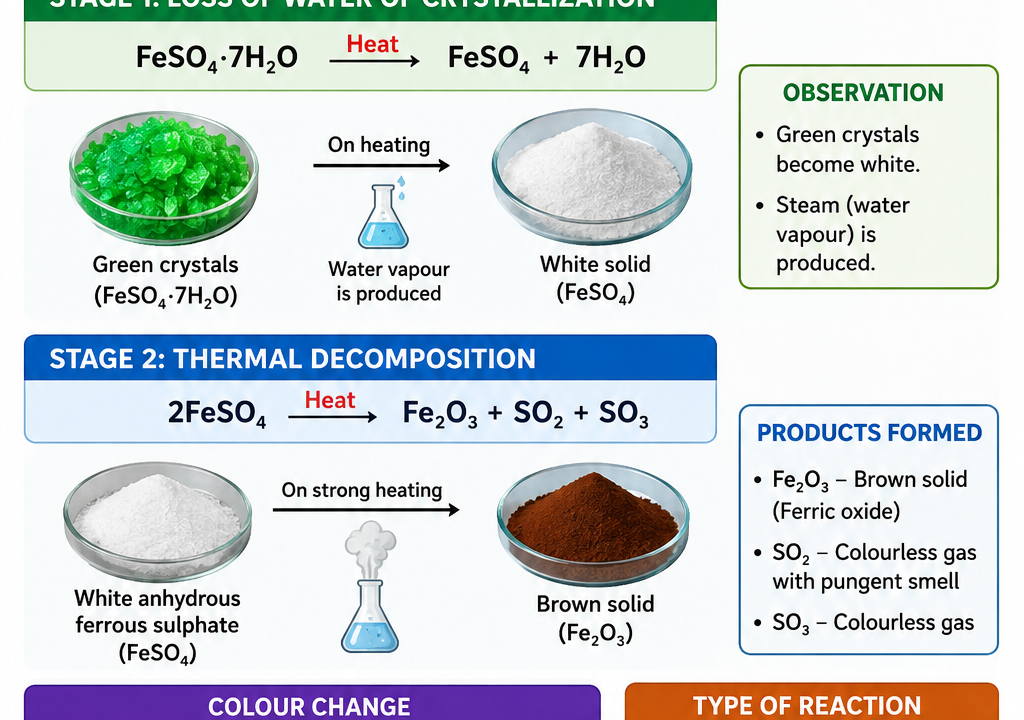
But, suppose we take zinc metal and hydrochloride and then mix it, it starts reaction with zinc metal and undergo chemical reaction and then form zinc chloride and hydrogen gas. Here two new substance formed. This is not a mixture.
Zn + 2HCl → ZnCl₂ + H₂
I hope you understand well.
Next example we take for more clear, if we take Sodium hydroxide and Hydrochloride acid and mix up, it again start chemical reaction and formed salt and water. Here you see that new substance are formed. hence it is not a mixture.
NaOH + HCl → NaCl + H₂O
IN MIXTURE : No new substance are fromed.
So , in the point of view of class 9 and class 10, i hope you understand well of what is mixture. you can read NCERT book of class 9 or 10 for more example.
Mixture is mainly two types:
- Homogeneous Mixture
- Heterogeneous Mixture
What is Homogeneous Mixture
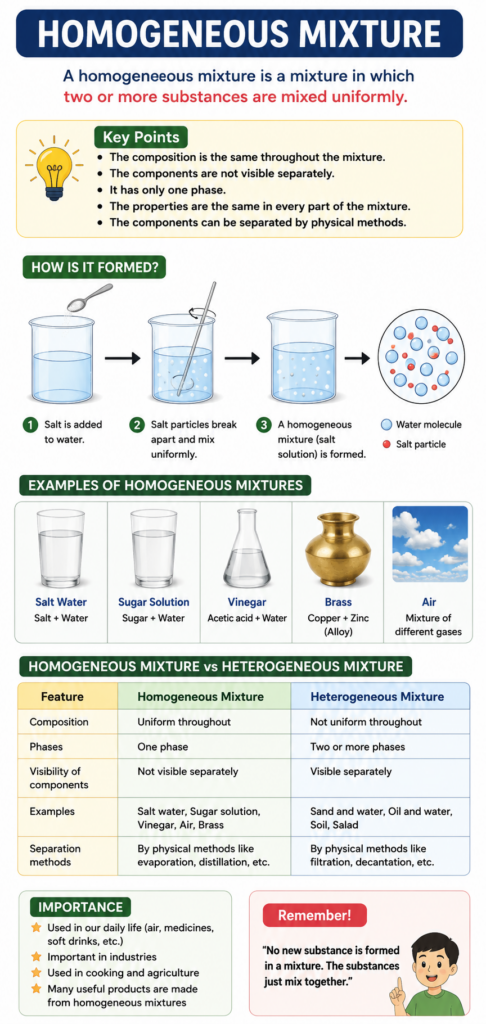
A Homogeneous mixture is a mixture when two or more substance can mix together in uniform way. It means that the distribution of substance over the mixture is same.
For example : sugar solution is a mixture of sugar and water. It is a homogenous mixture. Any portion of this solution contain the same proportion of sugar and water. In this solution we don’t have any visible separate particles of sugar and water.
What is Heterogeneous Mixture
A Heterogeneous mixture is a mixture that doesn’t have uniform composition of the substance. There are sharp boundaries between the various constituents of such a mixture.
For example : when we take a mixture of sand and water. This mixture called heterogeneous. The compositions of different parts of this mixture have different proportions of sand and water.
Examples of Homogeneous Mixture
- Air ( Mixture of Oxygen, Nitrogen, Carbon Dioxide, etc. )
- Salt water
- sugar solution
- Alcohol
- Perfume
- Brass ( Copper + Zinc )
- Steel ( Iron + Carbon )
- Vinegar ( Acetic Acid + Vinegar )
Components of a Homogeneous Mixture
There are mainly two components of Homogeneous Mixture that are solute and solvent.
What is solute.
The substance that taken in small quantity and which we dissolve in to mixture is known as solute.
For example : 1. sugar in water. Here sugar is a solute because it is dissolved in to water.
2 . Salt in water. here we dissolve salt in water.
What is solvent.
The substance which dissolve the solute and taken in large quantity.
For example : Water in salt solution: here water is taken in large quantity and it dissolve the salt , hence water is solvent.
Types of Homogeneous Mixtures
There are many types of Homogeneous mixture are:
A. Solid Homogeneous Mixtures
Examples:
- Brass
- Bronze
- Steel
B. Liquid Homogeneous Mixtures
Examples:
- Salt solution
- Sugar solution
- Vinegar
C. Gaseous Homogeneous Mixtures
Examples:
- Air
- Natural gas mixtures
How is a Homogeneous Mixture Formed?
A Homogeneous mixture is formed when solute is completely dissolved in to solvent resulting in uniform distribution in the solution.
A homogeneous mixture also be formed when one or more substance completely dissolved or mixed with another substance which makes uniform distribution of substance throughout the solution.
Example :
When we take a teasppon of salt and a glass of water. After we mix with these substance then the salt molecule is move apart.
The salt molecule is surrounded by water molecule and salt molecule goint to intermolecular space of the atoms. After salt molecule is spread throughout the water and looks disappear.
Thus, homogeneous mixture are formed.
Importance of Homogeneous Mixtures
Homogeneous mixtures play an important role in many fields:
In Daily Life
- Drinking water
- Soft drinks
- Perfumes
- Medicines
In Industry
- Manufacturing alloys
- Fuel production
- Chemical processing
In Medicine
- Syrups
- Saline solutions
- Injectable medicines
In Agriculture
- Pesticide solutions
- Fertilizers
Rate this article
Tap a star to rate
Was this helpful?
Sorry to hear that — what can we improve?
✓ Thanks for your feedback!