Osmosis is the process in which the movement of water molecules takes place from a region of higher water concentration to lower water concentration through a selectively permeable membrane.
Osmosis is an important process in our day-to-day life. Living organisms such as plants and animals do osmosis to maintain their lives. For example, plants use osmosis to absorb water from the soil, while animals use the same process to maintain the water amount inside their bodies.
So, osmosis is really an important biological process in nature that doesn’t need any mechanical energy. We will talk about osmosis in detail with an example. It is the important question of the biology of class 9, so, dear students, today I learned about it in detail.
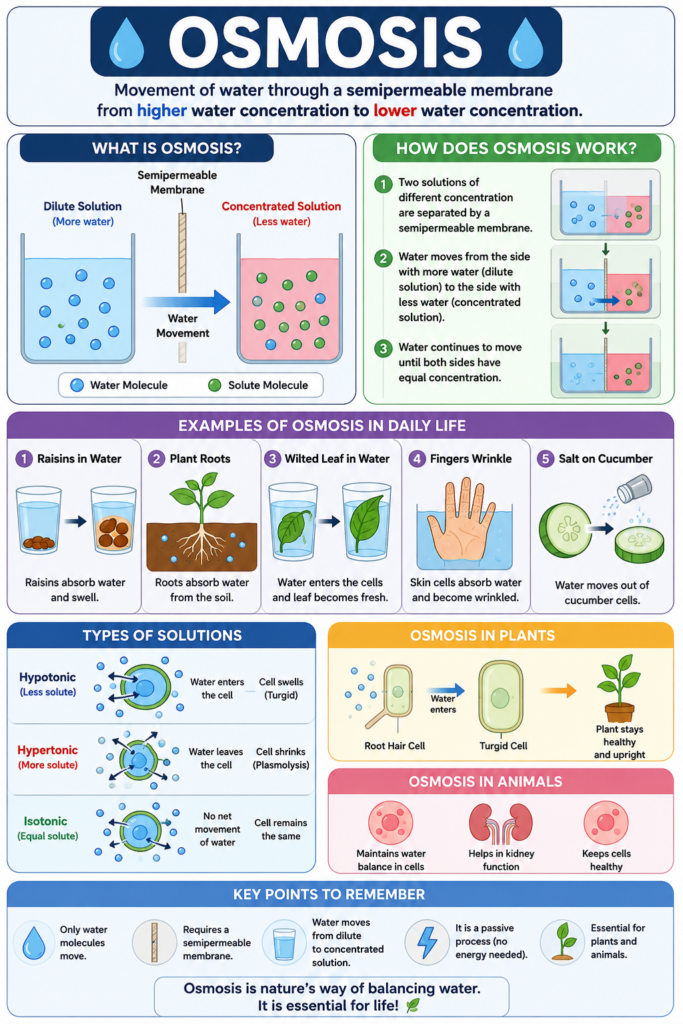
What is osmosis?
Osmosis is the process in which the movement of water molecules takes place from a region of higher water concentration to lower water concentration through a selectively permeable membrane.
Before going to the definition, dear students, please focus on the water molecule because all the concepts are around the water. I say this because osmosis is related to water concentration.
Also, students, you have to learn some more terms. The first is high water concentration, and the second is low water concentration. I say this because osmosis takes place because of different water concentrations.
High water concentration
You know that a solution consists of a solute and a solvent. When the amount of solute is less and the amount of solvent is more, then this solution is called high water concentration (if the solvent is water). Since water is the solvent, having more water and less solute means the solution has a high concentration of water molecules.
Low water concentration
When the solute is higher than the solvent, that means water is less in amount. Here, water is the solvent, so water is less in amount, and this says low water concentration.
I hope you understand the above ones. So let’s see the definition of osmosis.
What is osmosis, class 9, with an example?
Osmosis is the movement of water molecules from a region of higher water concentration (lower solute) to lower water concentration (higher solute) through a selectively permeable membrane.
Remember this line:
High water concentration = lower amount of solute or high water solvent.
Lower water concentration = High amount of solute or less water solvent.
Dear students, this is one of the easy definitions that I provided to you. Now for a clearer take, let’s take an example and a real-life example.
1. Raisins Swell in Water
You know raisins; it means “kismis” in Hindi. When we put raisins in normal water and then soak them for some hours, guess what will happen?
When dry raisins are soaked in water: you find that
- Water enters the raisins by osmosis.
- The raisins absorb water.
- They become soft and swollen.
Result: Raisins increase in size because water goes inside the raisin. This is the real example of osmosis. You can try it at home.
But what happens when a raisin is put in a salt solution? Does the raisin still swell up? Give your answer in the comment box.
2. Plant Roots Absorb Water
Do you ever try to know how plant roots absorb water, my dear students? Here again, the osmosis process takes place in root cells.
You know that root hair contains cells that have concentrated cell sap.
- Soil water has a higher water concentration as compared to root cells, which results in osmosis.
- Water moves into root hairs through osmosis.
- The absorbed water by roots finally travels to different parts of the plant through xylem vessels.
Result: Thus, plants receive water for growth.
3. Wilted Vegetables Become Fresh
A wilted carrot or spinach leaf regains its freshness when placed in water or sprinkled on it. You often see that a vegetable shopkeeper sprinkles water on vegetables, looking and making them fresh. Why? This is because osmosis takes place and water goes into vegetables and doesn’t make them dried up.
- Water enters the plant cells.
- Cells become swollen.
- Leaves or vegetables become firm again.
4. Fingers Wrinkle After Long Bath
You noticed that when you are bathing for a long time, your fingers get wrinkled. Do you ever think why this happened, students? This happened again by osmosis. When your fingers stay on water for long time, then water movement takes place and enter into the cell; this results in our fingers getting wrinkled.
When fingers stay in water for a long time:
- Water movement changes the outer skin.
- The skin forms wrinkles. b
This is commonly explained in school as an example related to osmosis; so far other biological mechanisms are also involved in nerve responses. I will tell you later in another article.
5. Salt on Cucumber
What happens when you sprinkle salt on cucumber? Did you try this earlier? If not, then try and find out what happened.
When salt is sprinkled on cucumber, the salt creates a concentrated solution outside the cell, and cucumber contains water in a good amount. Then osmosis occurs due to the difference in the water concentration. That result is water moves out of the cell, and you find that water droplets collect on the surface of the cucumber.
- Salt creates a concentrated solution outside the cells.
- Water moves out of the cucumber cells.
- Water droplets appear on the surface.
Important key terms of osmosis
| Term | Meaning |
|---|---|
| Water molecules | Molecules that move during osmosis |
| Solute | Substance dissolved in water for example (salt, sugar, etc.) |
| Solution | A homogeneous mixture of solute and water |
| Semipermeable membrane | A membrane that allows water to pass but blocks most solute particles in or out |
| Dilute solution | It contains more water and less solute. |
| Concentrated solution | It contains less water and more solute. |
Types of Solution in Osmosis
| Solution Type | Water Movement | Effect on Cell |
|---|---|---|
| Hypotonic | Water enters the cell | Cell swells |
| Hypertonic | Water leaves the cell | The cell shrinks |
| Isotonic | No net movement of water | The cell remains the same |
This article is dedicated to my students and provides easy theory, diagrams, and examples that are easy to understand for all classes, especially for class 9 biology. If you have more questions, please ask me at the ask page.
Rate this article
Tap a star to rate
Was this helpful?
Sorry to hear that — what can we improve?
✓ Thanks for your feedback!