
What is mitosis?
Mitosis is a type of cell division in which one parent cell divides to form two identical daughter cells. Also, the number of chromosomes in the daughter cell is the same as the parent cell. Each cell contains 23 pairs of chromosomes. It means it has a total of 46 chromosomes that contain our genetic information in the form of DNA.
The cell formed by the process of mitosis carries the same genetic information.
One Parent Cell (2n)
│
Mitosis
│
2 Identical Daughter Cells (2n)
For example:
- Growth of the body
- Repair of damaged tissues
- Replacement of old or dead cells
- Asexual reproduction in some organisms
Does mitosis occur in asexual reproduction?
Yes, mitosis occurs in asexual reproduction because the daughter cell formed by mitosis is genetically identical.
What is meiosis?
Meiosis is also a special type of cell division that produces four genetically different daughter cells, and each daughter cell contains half the number of chromosomes of the parent cells. That means it has only 23 chromosomes.
It only occurs in reproductive organs in an organism, such as male gametes (sperm) and female gametes (ovum).
One Parent Cell (2n)
│
DNA Replication
│
Meiosis I (1st division)
│
2 Daughter Cells (n)
│
Meiosis II (2nd division)
↙ ↘
Each of the 2 cells divides again
│
4 Daughter Cells (n)
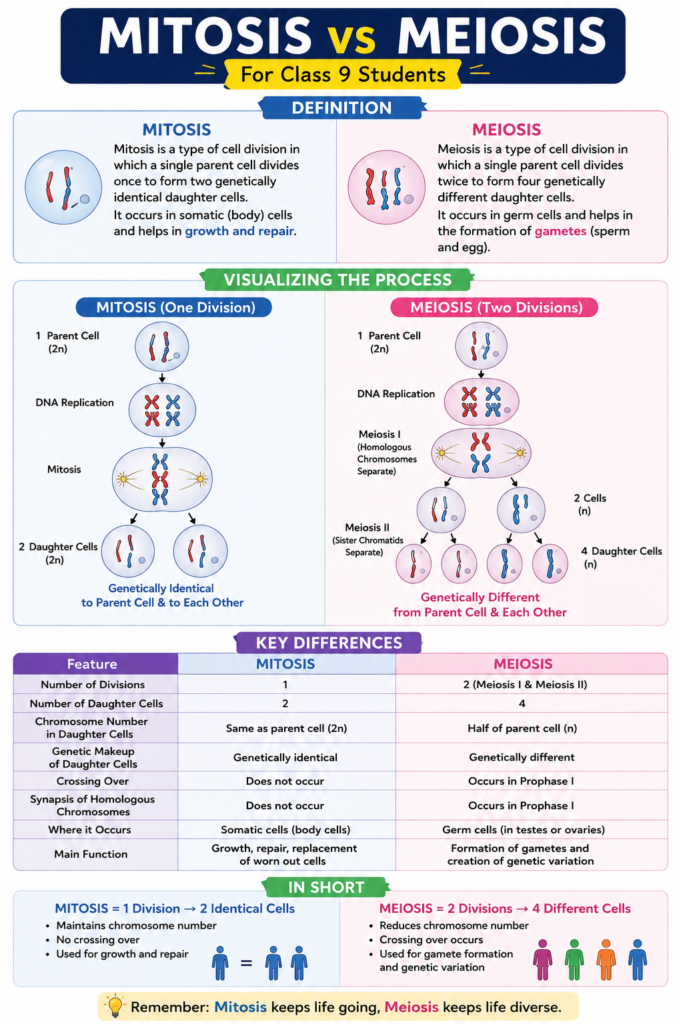
Difference Between Mitosis and Meiosis (Comparison Table)
| Feature | Mitosis | Meiosis |
|---|---|---|
| Definition | Produces two identical cells | Produces four different cells |
| Number of Divisions | One | Two |
| Daughter Cells | 2 | 4 |
| Chromosome Number | Remains the same (46) | Reduced by half (23) |
| Genetic Makeup | Identical | Different |
| Occurs In | Body cells | Reproductive cells |
| Purpose | Growth and repair | Gamete formation |
| Crossing Over | Does not occur | Occurs during Prophase I |
| Type of Cells Produced | Diploid (2n) | Haploid (n) |
| DNA Replication | Once before division | Once before Meiosis I |
| Importance | Tissue repair and growth | Sexual reproduction |
| Example | Repairing of skin cells | Formation of sperm and eggs |
Frequently Asked Questions (FAQs)
What is the main difference between mitosis and meiosis?
Mitosis produces two identical diploid cells for growth and repair; on the other hand, meiosis produces four genetically different haploid cells for sexual reproduction.
Why does meiosis produce four cells?
Meiosis has two successive rounds of cell division, meiosis 1 and meiosis 2, allowing one parent cell to produce four daughter cells.
Where does mitosis occur?
Mitosis occurs in body (somatic) cells, such as in our skin, muscle, and bone cells.
Where does meiosis occur?
Meiosis occurs in the reproductive organs, for example, in testes and ovaries, where sperm and egg cells are formed.
Does crossing over occur in mitosis?
No. Crossing over is not a feature of mitosis. It occurs only during prophase I of meiosis.
Why is meiosis important?
Meiosis is important because it produces gamete cells that maintain the correct chromosome number across generations and increases genetic variation that is responsible for evolution.
Which cell division is used for growth?
Mitosis is responsible for the growth and repair of tissues, bones, and cells.
Which cell division reduces chromosome number?
Meiosis reduces the chromosome number by half, that is, 23, and produces haploid cells.
This question is generally asked by CBSE and is also covered by NCERT books of class 9 or maybe class 11 biology. I hope you will find this content helpful. Thanks for reading, my dear students. If you have any questions, please ask me.
Follow on Twitter:
Rate this article
Tap a star to rate
Was this helpful?
Sorry to hear that — what can we improve?
✓ Thanks for your feedback!