Epithelial tissue is a special type of tissue that forms the outer covering of the body (skin), and it also lines the internal organs, such as the mouth, lungs, blood vessels, and intestine. It is made up of closely packed cells with little space between them.
📑 Contents 3 topics
It acts as a protective barrier against the entry of germs and helps to reduce the excess water loss. It also helps in the absorption, secretion, and movement of substances.
You can read more on the testbook of the Class 9 NCERT book.
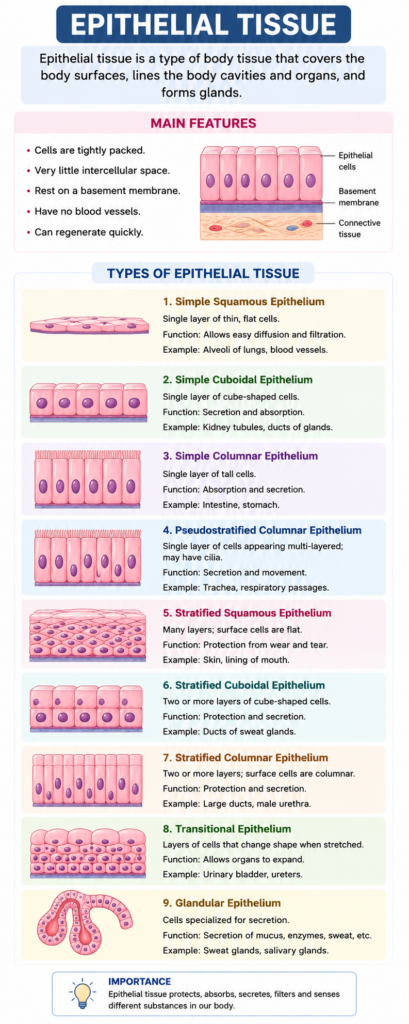
Function of Epithelial Tissue
Epithelial tissue performs many important functions in our body and also helps to coordinate with organs.
1. It helps in the rapid diffusion of liquid and gases in our body. For example, the lining of tissue in the blood vessels and lungs.
2. It acts as a protective underlying tissue from an injury and friction and prevents the entry of pathogens microorganism.
3. Secretion: It produces and secretes mucus, enzymes, hormones, and sweat on the skin and saliva on the mouth.
4. Sensory: It helps us to perform sensory functions like smell, taste, and sound.
5. Absorption: It balances the uptake of nutrients, water balance, etc.
Structure of Epithelial Tissue
1. It is a single layer of thin, flat cells. It is composed of many layers of cells. The outer cells are flat and tightly packed.
2. Those cells are specialized for producing and releasing many substances, like the salivary gland produce saliva. Sweat glands produce sweat, and the stomach produces mucus.
3. These cells, or specialized receptor cells, look like hair-like cilia. For example: nostrils in the nose and taste buds on the tongue.
4. Some epithelial tissue is a single layer of tall, pillar-like cells of a hair-like structure. For example: lining of the small intestine.
Types of Epithelial Tissue
According to NCERT class 9, there are 5 types of epithelial tissue that are found in our body and perform different functions.
| Type | Shape | Main Function | Example |
|---|---|---|---|
| Simple Squamous | Flat | Diffusion and filtration | Alveoli, blood vessels |
| Cuboidal | Cube-shaped | Secretion and absorption | Kidney tubules |
| Columnar | Tall | Absorption and secretion | Small intestine |
| Ciliated Columnar | Columnar with cilia | Movement of mucus or eggs | Trachea, Fallopian tube |
| Stratified Squamous | Many layers | Protection | Skin, mouth |
| Glandular | Secretory cells | Produces hormones and enzymes | Sweat glands, salivary glands |
Rate this article
Tap a star to rate
Was this helpful?
Sorry to hear that — what can we improve?
✓ Thanks for your feedback!